Why Some People Stay Inside Us (Part 1)
The inner life outlasts the outer relationship
As a trainee therapist, I’ve become increasingly aware that
some relationships do not end when contact ends. Certain people continue to
live vividly inside us, shaping how we feel, relate, and understand ourselves
long after the external relationship has changed or disappeared. For a long
time, I assumed this meant something had gone wrong that I was “not over”
someone, or that time hadn’t done its job. Training has helped me understand
this experience in a different way.
Psychodynamic theory suggests that we do not only relate to
people externally; we internalise them. These internalised relationships
become part of our inner world, influencing expectations, emotional reactions,
and patterns of attachment (Klein, 1946) and (Fairbairn, 1952). In this sense, it is
not unusual or pathological that some people remain psychologically present
long after they are physically absent.
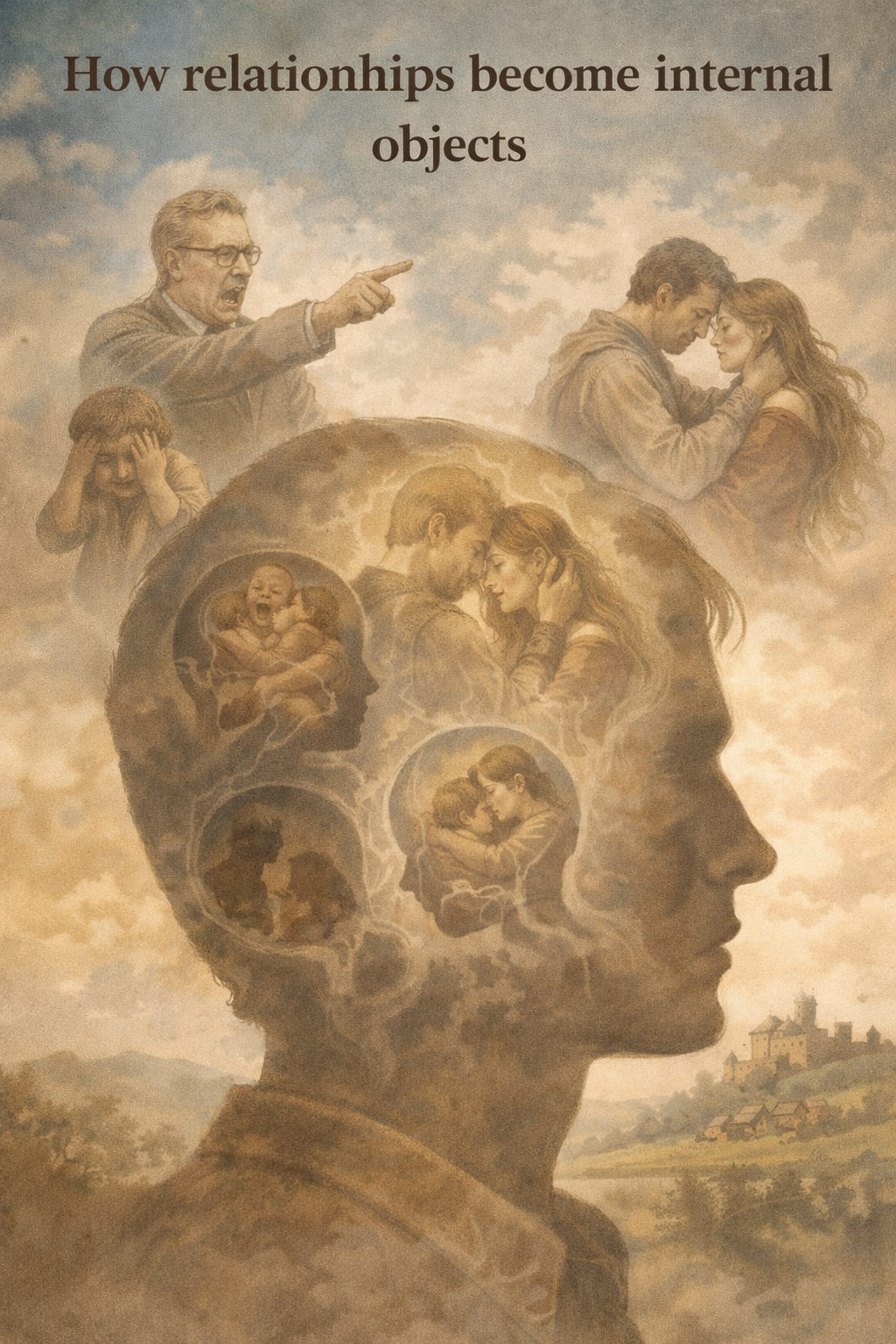
How relationships become internal objects
From early life onwards, we take in experiences of others
and form what object relations theorists call internal objects. These
are not literal representations of real people, but emotionally charged
impressions shaped by how we felt with them: whether we felt seen, needed,
safe, abandoned, overwhelmed or desired (Klein, 1946). These internal figures
become organising forces within the psyche.
Attachment theory offers a parallel view. Bowlby (1969)
describes how early attachment relationships shape internal working models expectations about ourselves and others that guide how we approach closeness,
loss and dependency. Later relationships can reactivate or reshape these
models, especially when they occur during periods of vulnerability or
transition.
In my own reflections, I notice that the people who linger most strongly inside me are those who entered my life at moments when something important was being reorganised internally: identity, belonging, worth or safety. Over time, I’ve come to see that what stays is often less the person themselves and more the psychological function they served.
Unfinished attachment and emotional residue
Some relationships end with clarity and mutual recognition.
Others end ambiguously, asymmetrically, or without the opportunity to fully
process what they meant. When this happens, the psyche may struggle to complete
the work of mourning.
Freud (1917) described mourning as the gradual withdrawal of
emotional investment from a lost object. When this process is disrupted by
confusion, idealisation, conflict or unresolved longing the internal object
can remain highly charged. The emotional residue of the relationship does not
stay neatly in the past; it is often carried forward into new relationships.
This residue may shape expectations (“I will be left”),
defences (“I must not need too much”), or desires (“If I am chosen, I will
finally be safe”). The past quietly infiltrates the present, often outside
conscious awareness.
When relational residue becomes neurosis
Over time, this carrying-forward of unresolved internal
objects can crystallise into what classical psychoanalysis calls neurosis.
Neurosis is not a crude label for illness, but a description of how outdated
relational patterns continue to organise present experience (Freud, 1914).
When internal objects remain rigid and unexamined, a person
may repeatedly encounter the same relational difficulties: chronic
disappointment, anxiety in intimacy, compulsive caretaking, fear of closeness,
or intense emotional reactions that feel disproportionate to the current
situation. The individual is not responding solely to the present; they are
replaying an old relational script.
From a trainee perspective, what strikes me is how intelligent
this process is. The psyche is not trying to sabotage the person; it is
attempting to resolve something unfinished. Freud described this as repetition
compulsion the tendency to repeat unresolved conflicts in the hope of
mastering them (Freud, 1914). The difficulty is that repetition alone does not
bring resolution; without reflection, the same story simply plays out with new
characters.
Transference: the past enters the present
These internalised relationships often become most visible
through transference. Feelings, expectations and roles originally
associated with earlier figures are displaced onto current relationships,
including the therapeutic one (Freud, 1912). In therapy, this allows past
patterns to be experienced live and reflected upon rather than enacted
unconsciously.
As a trainee therapist, encountering transference has been both unsettling and clarifying. It reveals how alive these internal objects really are, and how easily the psyche collapses time. Someone from the past can effectively step into the present wearing the face of a new person. Therapy does not aim to eliminate this process, but to make it visible enough that choice becomes possible.
Clinical vignette (anonymised)
All identifying details have been altered.
A client described repeatedly entering relationships where
they felt deeply needed at first, then gradually overwhelmed and resentful.
Each relationship ended with the same conclusion: “I give too much and then
I’m left.” In sessions, I noticed a subtle pull to reassure and rescue
them, alongside a quiet fear that if I failed to respond in the “right” way, I
too might disappoint them.
Over time, it became clear that the client had internalised
an early caregiving relationship in which love was closely tied to
responsibility. Care had to be earned through emotional labour. This internal
object was being carried forward into adult relationships and, at times,
installed into me through transference. What initially looked like “bad luck in
love” began to make sense as a repetition of an unresolved attachment pattern.
By slowing the process down and reflecting on what was
happening between us, the client gradually recognised how the past was
shaping the present. The aim was not to remove the internalised relationship,
but to loosen its grip, allowing new relationships to develop without being
organised around the same familiar script.
From repetition to working-through
Psychodynamic therapy aims not to erase the past, but to work
through its emotional residue. This happens gradually, through noticing
repeated patterns, recognising how past relationships are internalised, and
observing how these patterns show up in the therapeutic relationship.
Freud (1914) described working-through as the slow process
by which unconscious patterns are brought into awareness, experienced
emotionally, and integrated rather than compulsively repeated. Over time,
internal objects often soften. They become less idealised, less persecutory,
and less dominant.
Winnicott (1969) describes this shift as moving from being
dominated by internal objects to being able to use them recognising
them as internal representations rather than external realities. In lived
experience, this can feel like the person is still “inside,” but no longer
running the system.
Carrying the past with awareness
What I am learning, both personally and clinically, is that
some people stay inside us not because we are stuck, but because something
meaningful has not yet been fully integrated. We internalise relationships
because we are relational beings. We repeat because the psyche is trying to
resolve what once overwhelmed us.
When left unconscious, this repetition can harden into
neurosis. When brought into awareness, it can become a source of understanding.
Therapy offers a space where internal objects can be recognised, mourned, and
gradually transformed. The goal is not forgetting, but integration carrying
the past with less compulsion and more freedom.
As a trainee therapist, this perspective helps me hold both
my own inner life and my clients’ with greater compassion. The task is not to
purge the past, but to bring it into dialogue with the present. Some figures
may remain inside us, but with time and reflection, they no longer have to
dictate the future.
Looking ahead: what comes next
In Part 2, I will turn more directly to what happens when these internalised relationships enter the therapeutic space itself. While this first piece has focused on how internal objects and unfinished attachment shape our lives outside therapy, the next will explore how these patterns come alive between client and therapist through transference and countertransference.
Alongside this, I will introduce the core ideas of psychodynamic theory, including how it understands the unconscious, repetition, and the central role of the therapeutic relationship in psychological change. I will reflect on how the consulting room becomes a living laboratory in which past dynamics are replayed, felt, and potentially transformed, and on the ethical importance of boundaries and containment in holding this work. In this way, Part 2 will move from why some people stay inside us to what we do when they arrive in the room.
References
- Bowlby, J. (1969) Attachment and Loss: Volume I – Attachment. London: Hogarth Press.
- Fairbairn, W.R.D. (1952) Psychoanalytic Studies of the Personality. London: Tavistock Publications.
- Freud, S. (1912) The Dynamics of Transference. In: The Standard Edition of the Complete Psychological Works of Sigmund Freud, Vol. 12. London: Hogarth Press.
- Freud, S. (1914) Remembering, Repeating and Working-Through. In: The Standard Edition of the Complete Psychological Works of Sigmund Freud, Vol. 12. London: Hogarth Press.
- Freud, S. (1917) Mourning and Melancholia. In: The Standard Edition of the Complete Psychological Works of Sigmund Freud, Vol. 14. London: Hogarth Press.
- Klein, M. (1946) Notes on Some Schizoid Mechanisms. International Journal of Psychoanalysis, 27, pp. 99–110.
- Winnicott, D.W. (1969) The Use of an Object. International Journal of Psychoanalysis, 50, pp. 711–716.