The Collective Unconscious in the Room (Part 4)
Notes From Training (Part IV)
When Insight Is Followed by Backlash
Part I was my “first doorway”: the idea that a collective
unconscious might be a useful way of naming how certain emotional architectures
reappear across lives and cultures less as superstition, more as an observable
repetition in form (Carl Jung, 1959/1981).
Part II was the slightly unnerving upgrade: it isn’t just
that clients “have archetypes” sometimes; it can feel like archetypal patterns
have agendas, and they recruit both people and relationships as a kind of
theatre (Jung, 1966).
Part III then got more clinical: what happens when a pattern is named how it can intensify, resist, and “push back,” not as a demon, but as a long-standing psychic organisation protecting the person from something it believes would be worse (Sigmund Freud, 1914) and (Sigmund Freud, 1920) and (Jung, 1960).
So Part IV is where we go into rougher weather: what happens
when insight is followed by backlash; when the old story doubles down; when
both client and therapist have to decide whether they will stay with new
awareness or retreat into familiar drama. And then because I promised it Part
IV widens out: how archetypal patterns don’t arrive fully formed in one
lifetime, but thicken over generations, as families, cultures, and institutions
keep rehearsing the same scenes until the choreography starts to feel like
“just the way things are” (Émile Durkheim, 1912/1995) and (Jan Assmann, 2011).
After the insight: why things can look worse before they look different
There is a fantasy especially early in training that once
you “name the pattern,” the pattern politely thanks you, gives you a Blue Peter
badge, and leaves. In real rooms, with real nervous systems, it often does the
opposite: it tightens, or it tests, or it tries to recruit the relationship
back into the old script.
Freud’s language for this remains unglamorous but accurate.
Resistance is not just the client being difficult; it is the psyche defending a
compromise that has been keeping something bearable (Freud, 1914). And
repetition compulsion is not stupidity; it is often the psyche returning to a
familiar scene because familiarity feels safer than the unknown even when the
familiar is painful (Freud, 1920). In practice, that means insight can feel
like standing at the edge of a cliff: the mind can see more clearly, but the
body still responds as if change equals danger.
Jung frames it differently but arrives at a similar clinical
observation: an activated complex can temporarily “take over” the ego’s freedom
of movement, narrowing choice and intensifying affect (Jung, 1960). When I
translate that into trainee-English, it becomes: if we move too close to the
protected centre too quickly, the system flares.
Composite vignette: the “rescuer” after the naming
A client begins to recognise a lifelong position: “I’m
always the one who fixes it. I don’t know who I am if I stop.” There is relief
in naming it almost a softening. Then, the next week, they rescue harder: extra
tasks, extra caretaking, extra responsibility, extra apologies for “taking up
time.”
If I don’t recognise this phenomenon, I panic and assume I
have made it worse. If I do recognise it, I treat the flare-up as information.
The role is not just behaviour; it is identity. The role is
not just identity; it is protection. The role is not just protection; it is
loyalty to a story about survival. This is where “working-through” matters:
insight is a doorway; working-through is the long corridor where the old reflex
keeps reappearing, and the client practises not obeying it every single time
(Freud, 1914). It is repetitive in the honest sense, and that repetition is not
failure it is the work.
What the backlash often protects
Backlash is rarely random. It is usually protecting
something load-bearing, and the protective logic often sounds like one (or
several) of these:
- Belonging: “If I stop performing, I’ll be left.” (John Bowlby, 1969) and (John Bowlby, 1988)
- Goodness: “If I stop, I’ll be selfish / bad.” (This is where you can feel the internalised moral economy of a family or culture: who earns love, who is allowed need, who is permitted rest.)
- Safety: “If I don’t manage everything, something terrible will happen.” (Often a rational fear, once upon a time; then later a generalised alarm.)
- Meaning: “If I stop, I don’t know who I am.” (And this one can be existential: if identity has been organised around a role, removing the role can feel like losing the self.)
In other words, backlash is the psyche saying: you are near
the load-bearing wall; do not knock it down too quickly.
How this looks beyond the “rescuer”
In the room, I see this “after-insight flare” in several
costumes:
- The
apologiser notices they apologise when anxious, then arrives flooded with
apologies trying to buy safety through self-erasure.
- The
intellectualiser has one moment of felt contact, then returns with a
thesis more coherence, more analysis because emotional closeness feels
like exposure.
- The
avoider names their disappearing, then misses a session not out of malice,
but because being seen has been paired with danger for too long.
- The
“good client” names pleasing, then becomes either hyper-compliant (“Tell
me exactly what to do”) or suddenly oppositional (“This is useless”), both
of which can be attempts to restore a familiar structure.
The training task for me is to read these not as sabotage,
but as nervous-system literacy: the person is learning a new way to be in
relationship, and the old protective circuits still fire.
When the old story doubles down: the relational pull back into role
Part III touched something I keep meeting: a pattern does
not only live “in” the client; it often tries to reconstitute itself between
us.
This is where countertransference stops being a textbook
word and becomes a bodily event: an urge to rescue, to correct, to impress, to
withdraw, to become perfectly understanding, to become strict. The role arrives
with emotional pressure almost like stage directions and if I am not careful, I
begin acting in a way that feels strangely “unfree”.
Thomas Ogden’s idea of “the analytic third” helped me here:
there is the client’s subjectivity, the therapist’s subjectivity, and the
jointly-created psychological field that can start to feel like its own
atmosphere (Ogden, 1994). When the field becomes thick, it is often because
something archetypal is being rehearsed not as theatre for entertainment, but
as an old relational choreography trying to happen again.
Composite vignette: “Judge and Defendant”
A client comes with a history of being assessed, criticised,
shamed. We name it gently: “It sounds like there’s an expectation you’ll be
found lacking.”
The next sessions arrive with tests: lateness, provocation,
a careful watching of my face.
What is being tested is not my knowledge. It is whether I
will accept the role of Judge so the client can return to the familiar role of
Defendant. If I step into it subtly disapproving, subtly instructing I confirm
the old world. If I refuse it harshly (“I’m not your parent”), I still enact a
version of the old world: authority, rejection, humiliation.
The work is relational restraint: to stay human, boundaried, and interested, so the client can experience something new without being humiliated by it (Carl Rogers, 1957) and (Carl Rogers, 1961).
Sometimes the pattern is “Abandoned Child / Saviour”. The
client becomes increasingly distressed and I feel a heroic urgency to be
endlessly available. If I gratify it, I become the rescuer; if I refuse it
coldly, I become abandonment. The work is to offer a secure-enough presence
without turning therapy into a rescue mission (Bowlby, 1969) and (Rogers, 1957).
Sometimes it is “Performer / Audience”. The client brings
charisma, humour, stories and I feel pressure to laugh, to admire, to be
entertained. The intimacy stays safe because it stays performative. The work is
to invite what is underneath the performance without shaming the defence
(Freud, 1914) and (Jung, 1960).
Sometimes it is “Parentified One / Helpless Other”. The
client takes care of me checks my wellbeing, worries about my tiredness, tries
to manage my feelings. If I accept it as normal, we rehearse their old job. If
I reject it sharply, we risk repeating the experience of being “wrong” for
caring. The work is to receive the care as information, then return the
attention to what it costs them, and what it protects, while staying warm
(Rogers, 1961).
This is the point where therapy stops being purely
interpretive. It becomes a discipline of not enacting. Often the most
therapeutic thing in the room is not a clever formulation but a steady refusal
to become the cast member the pattern demands.
The fork: stay with the new awareness, or retreat into the familiar drama
This is the decision-point I meant in Part III: once a
pattern is conscious, both therapist and client face a fork.
Staying with new awareness often means tolerating
uncertainty, grief, guilt, and the sense of “I don’t know who I am yet.”
Retreating into the familiar drama often restores immediate certainty at the
cost of repeating the same outcome.
Clinically, I am learning that this fork appears in small
moments rather than grand declarations. It looks like a client noticing the
urge to apologise and pausing. It looks like a client feeling the pull to
over-function and doing one task less. It looks like a client saying something
honest instead of something pleasing. It looks like a therapist noticing the
urge to rescue and choosing to stay curious instead.
Jung’s emphasis that consciousness modifies the relationship
to what is constellated matters here not because consciousness “wins”, but
because it changes the terms of engagement (Jung, 1959/1981) and (Jung, 1960). The
archetype does not vanish; it becomes negotiable. And “negotiable” often means:
we can name the pressure without obeying it, feel the fear without turning it
into a role, tolerate not knowing long enough for something new to form.
Breaking the spell: the quietly dangerous acts
Now we come to the part I find most moving in practice:
moments that look small on the outside and feel seismic on the inside.
The “good daughter” says no without justification. The
“unseen son” takes up space without apologising. The “rescuer” sits on their
hands and lets someone else stand up.
These are not just behavioural changes; they are identity
ruptures. The psyche often treats them like betrayal of family rules,
betrayal of cultural scripts, betrayal of the old inner contract (“If you
perform, you belong”).
Attachment theory keeps this grounded: if a person’s early world taught them that connection is conditional, then breaking the old condition can feel like risking abandonment (Bowlby, 1969) and (Bowlby, 1988). Freud keeps it honest: if the old role managed forbidden wishes and fears, stepping out of it will provoke anxiety and resistance (Freud, 1914) and (Freud,1920). Rogers keeps it humane: if the client can experience acceptance while experimenting with a new position, the nervous system can learn that authenticity does not automatically cost love (Rogers, 1957).
What I am learning as a trainee in these moments
The temptation is to celebrate too quickly. But often the
client is not ready for celebration; they are in shock. The work is slower, and
it tends to look like this:
- Make room for the fear: “Something in you expects punishment for doing this.”
- Name the grief: “If you stop being the rescuer, you lose a whole identity.”
- Respect the loyalty: “Part of you still believes you owe them your goodness.”
- Track the body: “Where does the anxiety land when you don’t perform?”
- Go gently: “We’re not erasing the old self; we’re widening the cast list.”
These are the moments where the therapy room stops being a
place of clever formulations and becomes a place of moral courage quiet,
unglamorous, real.
Centuries of rehearsals: how archetypes thicken over generations
Part III also promised that Part IV would explore how
archetypal patterns do not arrive fully formed in one lifetime; they thicken
over generations. I want to say that carefully.
I do not mean we inherit a ready-made mythological character
like a family heirloom. I mean something more observable: families, cultures,
and institutions keep replaying similar scenes exile, sacrifice, rescue,
betrayal, redemption and each repetition adds another layer of expectation
about “how this kind of story goes.” Over time, the repetition becomes
choreography: who must carry what, who must be good, who must be blamed, who
must not need.
This is where cultural and social theory is helpful in a
non-mystical way. Durkheim wrote about collective forces shaping individual
life shared meanings that feel bigger than any one person (Durkheim,
1912/1995). Assmann’s work on cultural memory articulates how groups store and
transmit meaning through narrative, ritual, and social remembrance, so that
people can find themselves living inside inherited story-structures without
consciously choosing them (Assmann, 2011). Arnold van Gennep and Victor Turner
describe rites of passage as social processes that organise identity separation,
liminality, reintegration and once you see that, you begin to notice how modern
life still contains unofficial rites and roles (Van Gennep, 1909/1960) and (Turner,
1969).
In families, these rehearsals can be subtle. One generation
prizes silence and endurance. Another calls that “strength” and repeats it. A
third experiences it as emotional absence and repeats it differently perhaps
through frantic caretaking, chronic self-reliance, or a private vow never to
need anyone. Each generation changes the costume. The underlying pressure
remains recognisable.
So when a client and therapist begin to see an archetypal
pattern clearly, they are not only meeting one person’s history. They may be
brushing against centuries of rehearsal: the old choreography of “who must
carry what,” “who must be good,” “who must be blamed,” “who must not need.”
The Changeling in Irish and Scottish Gaelic tradition
To make the “thickening” idea concrete in a particular
European cultural world, I use the Changeling from Irish and Scottish Gaelic
folk tradition. In its classic form, a child is believed to be “swapped” by the
fair folk an uncanny replacement that looks similar but feels not-quite-right
(W. Y. Evans-Wentz, 1911) and (Katharine Briggs, 1976).
As a trainee therapist, I am not interested in treating this
as literal belief. I am interested in the psychological and relational shape
the story provides: a culturally available way to name rupture around
caregiving especially at thresholds like birth, infancy, illness, or
developmental difference when a caregiving system cannot metabolise what it is
feeling. The story offers a ready-made externalisation: it is not me; it is not
us; it is not even really the child. In other words, the distress is displaced
into narrative.
Scholars have examined how changeling narratives
historically intersect with folk explanations for disability or developmental
difference again, not as a neat one-to-one mapping to modern diagnosis, but as
a way societies make sense of feared difference (Susan Schoon Eberly, 1988) and (Joyce Underwood Munro, 1997).
What matters for our purposes is how cleanly this example
demonstrates thickening. You can see the layers accumulate: a folkloric story
that names rupture; a boundary function that polices what counts as “normal”
and “proper”; a threshold function that clusters around liminal moments; an
aesthetic afterlife as the “uncanny child” becomes a portable emotional
template; and then a private family layer where the shape persists even without
literal belief.
This is also where I find Mary Douglas useful. Her work on
purity and boundary logic helps me think about how cultures stabilise
themselves under anxiety by tightening categories of belonging and otherness
(Douglas, 1966). The changeling becomes, in that sense, a boundary figure: the
not-quite-belonging dependent, the uncanny other, the one who carries what the
system cannot bear.
The clinical translation is not that a client “is a
changeling”. The clinical translation is that a client may have been positioned
as if they were one: the strange one, the too-much one, the wrong one, the one
whose needs land as threat. Often the client’s deepest pain is not simply what
happened, but what was implied: that their difference made them
unlovable, or that their need made them dangerous.
And this is where the ethical boundary matters. Changeling
beliefs have historically been associated with harmful responses to vulnerable
children. That matters. So I do not use this archetype to romanticise the past
or aestheticise suffering. I use it to name a sober dynamic: cultures hand us
story-templates for managing fear and difference; those templates can protect,
but they can also injure. Therapy tries to create a third option: a space where
fear and difference can be held without turning someone into “the
not-really-one-of-us.”
Wotan as an archetypal “weather system” over time
When Jung wrote his essay “Wotan” (first published in 1936),
he treated Wotan (Odin) not merely as a historical deity, but as a
psychological factor a cultural-archetypal energy that can be “constellated”
under certain social conditions (Jung, 1936/1970). One can disagree with Jung’s
framing, but clinically the shape of what he is pointing to is worth
considering: when societies destabilise, certain mythic patterns warrior,
wanderer, berserker, possessed crowd can become psychologically “available”
again, offering intoxication, unity, and permission.
What matters for the point about “layers” is this: an
archetype does not move through history like a single object. It thickens
through repetition, representation, and reuse. In the Wotan case, you can watch
the thickening occur as the image migrates through domains: an older mythic
figure; a folkloric survival in images like the Wild Hunt; an aesthetic
re-staging that gives the figure new emotional clothing; a political
appropriation that mobilises identity and action; and then a private layer
where individuals internalise the cultural script what it means to be “strong,”
“pure,” “loyal,” “dangerous,” “chosen,” “fated.”
This is not mystical inheritance. It is a feedback loop
between story, symbol, institution, and psyche exactly the kind of loop
Durkheim and Assmann help us describe sociologically (Durkheim, 1912/1995) and (Assmann, 2011).
The painting detail: the “Wotan image” that later viewers see as Hitler-like
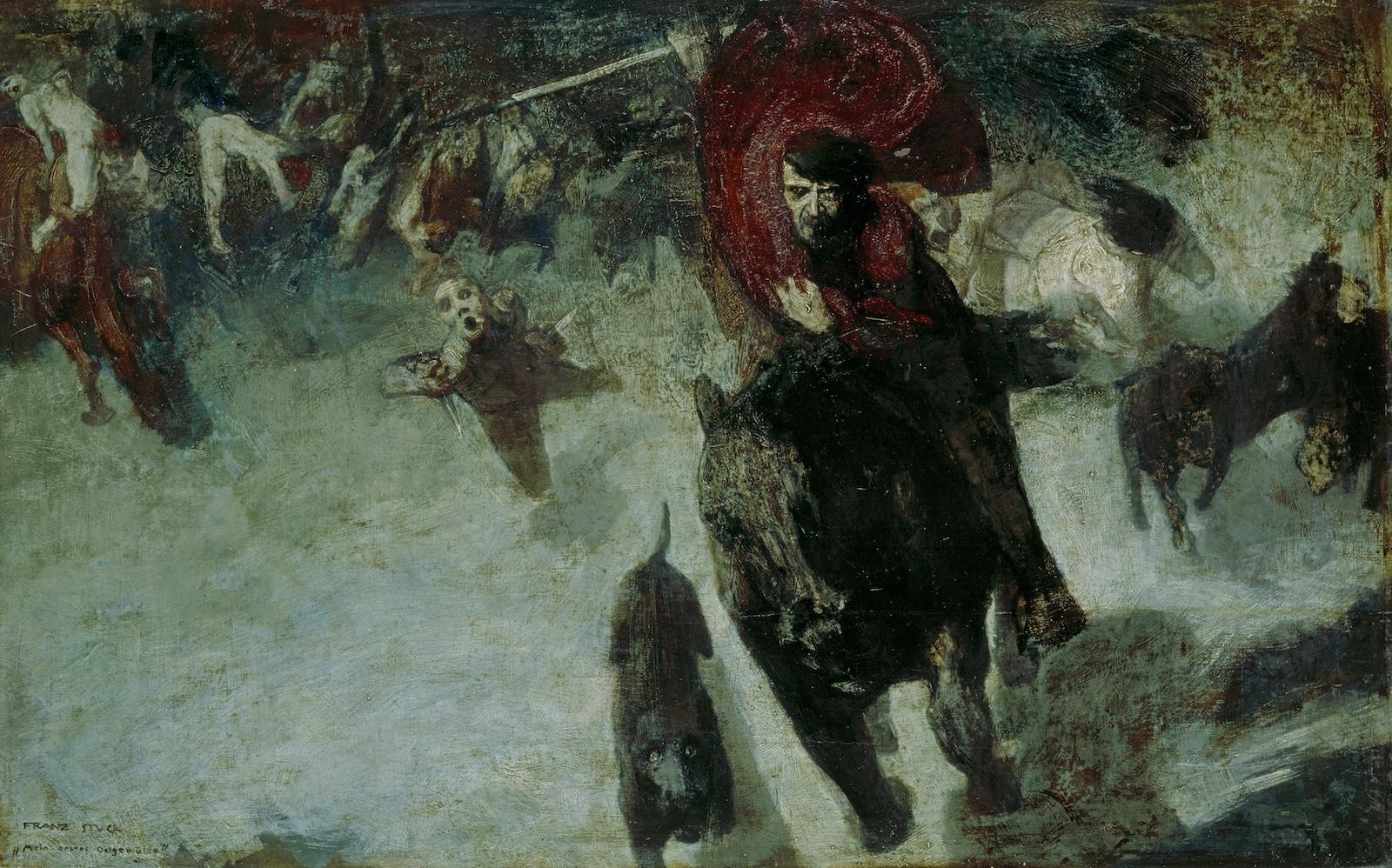
As a trainee, I also want to be careful about how we speak
about images like Stuck’s Die Wilde Jagd. Some modern viewers have
remarked that the central rider can look uncannily like Adolf Hitler. I hold
that observation lightly. It reads to me as retrospective resemblance a later
mind seeing a familiar face in an earlier image rather than any serious claim
of prophecy or direct modelling. Popular “birth-year” theories sometimes get
added on top of this; I treat those as cultural after-stories rather than
reliable causation.
But even if we remove the sensational layer entirely, the
psychological point still matters. An image like that can compress an
atmosphere frenzy, night-riding, intoxicated leadership, the stampede of the
crowd into a single, portable symbol. And once history has happened, later
generations do not meet the image with neutral eyes. They meet it with memory,
association, and emotional sediment. In that sense the archetype thickens: not
because the past predicted the future, but because the future teaches a culture
how to reread its past. What changes is not the paint on the canvas, but the
layer of meaning carried in the viewer: how the collective imagination has been
shaped by what came later, and how symbols quietly accumulate charge across
time.
Bringing it back to the room
This is why “centuries of rehearsals” is not just an
interesting cultural lecture; it lands in session.
A client does not only have a personal history. They often
have a history-within-a-history: family roles repeated so often they feel
ordained; cultural ideals repeated so often they feel like morality itself;
institutional scripts repeated so often they feel like reality.
So when a client tries to break the spell say no, take up
space, stop rescuing they may be resisting not only a personal habit, but a
rehearsed story about who they are allowed to be.
And that is why the backlash can be so intense. They are not
only changing behaviour. They are challenging a “law” that has been repeated
until it feels like truth.
Where Part IV Leaves Me
If Part III was about what happens when a pattern is seen
and begins to push back, Part IV has been about staying in the room when that
pushback becomes weather: backlash after insight, the old story doubling down,
the relational pull back into role, and the quietly dangerous moments when a
client begins to break the spell.
What I am learning slowly, and sometimes only after I have
learned it the hard way, is that backlash is not always a detour from the work.
Often it is the work. It is the moment the psyche reveals how much the old role
has been doing: how it protected belonging, managed fear, prevented shame, kept
attachment stable, gave identity a shape. When a client steps even slightly out
of that role, the system behaves as if a long-standing safety mechanism has
been switched off. Alarm signals rise. Guilt blooms. Old loyalties flare. And
if I do not understand this, I can misread it as failure, or rush in to tidy it
up either by pushing for reassurance (“See, you’re fine!”) or by reaching for
interpretation that is too big for the moment.
As a trainee, I still notice how easily I want
transformation to be clean and conclusive. A part of me wants a satisfying
narrative arc: insight → relief → change. But the work keeps teaching me
something more sober and more hopeful: the psyche rarely changes through a
single insight. It changes through repeated, supported choices made in the
presence of relationship choices that can look tiny on the outside and feel
enormous on the inside. Not grand reinventions, but small moments of refusing
the automatic line-reading: one “no,” one pause before apologising, one honest
sentence, one week of not rescuing, one act of staying with discomfort long
enough for the nervous system to realise it does not have to call it danger.
And the wider view matters too. The idea of “centuries of
rehearsals” helps me stay humble. Some patterns are older than the client’s
biography. Some are older than their family. Some have been circulating through
cultural stories, institutions, and symbolic systems for a very long time. That
does not make anyone doomed; it just means the script is well-practised, and
sometimes socially rewarded. When a client starts changing, they may be
stepping out of something that has been rehearsed across generations as
“normal,” “good,” “loyal,” or “strong.” No wonder the backlash can feel like
betraying a law rather than changing a habit.
So where does that leave me, at the end of Part IV? It
leaves me with a deeper respect for slowness. It leaves me more cautious about
forcing meaning too quickly. It leaves me more attentive to the difference
between a client’s growth and my own wish to feel effective. And it leaves me
with a clearer sense of what the ethical task is in this kind of work: not to
smash archetypes, not to worship them, but to help a person relate to them with
enough consciousness that the archetype becomes an influence rather than a
ruler.
Part V: What Comes Next
Part V will move into a different kind of discipline: what
happens after the spell has been cracked.
Because breaking the old script is only half the story. The
next question is the one clients often meet in a quiet, unsettled way: if I am
not that role, who am I? If I am not the rescuer, the good one, the invisible
one, the one who carries everyone what shape does my life take now? What does
“me” look like without the pressure of the old choreography?
This is where the idea of a personal myth becomes clinically
useful not as a grand fantasy, and not as an identity costume, but as a way of
organising meaning without becoming trapped inside meaning. Part V will explore
how a person can begin to author a life-story that is honest, flexible, and
human one that can hold archetypal material without being swallowed by it. The
aim is not to “destroy” archetypal images, or to pretend we are free of them.
The aim is to learn how to relate to powerful symbols without becoming inflated
by them, terrified of them, or morally licensed by them.
In practical terms, Part V will look at questions like: how
do we recognise when an archetypal image is offering meaning and when it is
demanding obedience? How do we work with depth and symbolism while staying
ethically grounded and accountable in ordinary human consequences? How do we
help a client carry “big” inner material hero, martyr, exile, redeemer without
collapsing into certainty, superiority, or shame? How do we let the image
inform the psyche while keeping the person in the driver’s seat?
And perhaps most importantly, Part V will explore a kind of
humility that training keeps demanding: the capacity to let a client’s story
become theirs, rather than making it an archetypal performance. To help someone
find meaning, without forcing them into an image. To let myth serve life,
rather than letting life serve myth.
That is where the thread goes next: from breaking the spell,
to learning how to live without needing another spell to replace it and the mass mobilisation of groups when archetypal activation occurs.
Reference list
- Assmann, J. (2011) Cultural Memory and Early Civilization: Writing, Remembrance, and Political Imagination. Cambridge: Cambridge University Press.
- Bowlby, J. (1969) Attachment and Loss, Vol. 1: Attachment. New York: Basic Books.
- Bowlby, J. (1988) A Secure Base. London: Routledge.
- Briggs, K.M. (1976) *An Encyclopedia of Fairies: Hobgoblins, Brownies, Bogies, and Other Supernatural Creatures. New York: Pantheon.
- Douglas, M. (1966) *Purity and Danger: An Analysis of Concepts of Pollution and Taboo. London: Routledge.
- Durkheim, É. (1912/1995) The Elementary Forms of Religious Life. Translated by K.E. Fields. New York: Free Press. (Original work published 1912).
- Eberly, S.S. (1988) ‘Fairies and the Folklore of Disability: Changelings, Hybrids and the Solitary Fairy’, Folklore, 99(1), pp. 58–77.
- Evans-Wentz, W.Y. (1911) The Fairy-Faith in Celtic Countries. London: Henry Frowde / Oxford University Press.
- Freud, S. (1914) ‘Remembering, repeating and working-through’, in Strachey, J. (ed. and trans.) The Standard Edition of the Complete Psychological Works of Sigmund Freud, Vol. 12. London: Hogarth Press, pp. 145–156.
- Freud, S. (1920) Beyond the Pleasure Principle. Translated by J. Strachey. Vienna: Internationaler Psychoanalytischer Verlag.
- Jung, C.G. (1936/1970) ‘Wotan’, in Civilization in Transition (Collected Works, Vol. 10). Princeton, NJ: Princeton University Press. (Original essay published 1936).
- Jung, C.G. (1959/1981) The Archetypes and the Collective Unconscious (Collected Works, Vol. 9, Part 1). Princeton, NJ: Princeton University Press.
- Jung, C.G. (1960) The Structure and Dynamics of the Psyche (Collected Works, Vol. 8). Princeton, NJ: Princeton University Press.
- Jung, C.G. (1966) Two Essays on Analytical Psychology (Collected Works, Vol. 7). Princeton, NJ: Princeton University Press.
- Munro, J.U. (1997) ‘The Invisible Made Visible: The Fairy Changeling as a Folk Articulation of Failure to Thrive in Infants and Children’, in Peter Narváez (ed.) The Good People: New Fairylore Essays. Lexington, KY: University Press of Kentucky, pp. 251–283.
- Ogden, T.H. (1994) ‘The analytic third: working with intersubjective clinical facts’, International Journal of Psycho-Analysis, 75, pp. 3–19.
- Purkiss, D. (2000) *At the Bottom of the Garden: A Dark History of Fairies, Hobgoblins, and Other Troublesome Things. New York: New York University Press.
- Rogers, C.R. (1957) ‘The necessary and sufficient conditions of therapeutic personality change’, Journal of Consulting Psychology, 21(2), pp. 95–103.
- Rogers, C.R. (1961) On Becoming a Person: A Therapist’s View of Psychotherapy. Boston: Houghton Mifflin.
- van Gennep, A. (1909/1960) The Rites of Passage. Translated by M.B. Vizedom and G.L. Caffee. Chicago: University of Chicago Press. (Original work published 1909).
- Turner, V. (1969) The Ritual Process: Structure and Anti-Structure. Chicago: Aldine.
- Lenbachhaus (n.d.) ‘Franz von Stuck, Die Wilde Jagd, um 1888’ (collection listing). Accessed: 3 February 2026.
- International Association for Analytical Psychology (n.d.) ‘Collected Works, Vol. 10: Civilization in Transition’ (abstract/summary page). Accessed: 3 February 2026. (IAAP)
- Yale University Press Scholarship Online (n.d.) ‘Ario-Germanic Paganism, Indo-Aryan Spirituality, and the Nazi …’ (chapter preview). Accessed: 3 February 2026. (yale.universitypressscholarship.com)
- Nighswander, L. (2020) ‘No Nazis in Valhalla: Understanding the Use (and Misuse) of Norse symbolism’ (paper). Accessed: 3 February 2026.