Astrology as Symbolic Language in the Therapy Room
A reflective account from a trainee therapist
This article presents a reflective account of clinical
work undertaken during psychotherapy training, in which astrology emerged as a
significant symbolic framework within the therapeutic relationship. Rather than
approaching astrology as a belief system to be endorsed or challenged, the
reflection explores how astrological language functioned psychologically,
shaping the client’s way of organising experience, regulating anxiety, and
narrating inner life. Drawing on psychodynamic and Jungian perspectives, the
account considers how symbolic systems, including astrology, can express
unconscious processes, attachment dynamics, and archetypal patterns in the
therapy room. The focus is on learning and clinical development, highlighting
how attention to symbolic meaning and the therapist’s own responses supported
deeper understanding of the work.
A Symbolic System Enters the Therapy Room
I did not expect astrology to become clinically important to
me so quickly. I assumed it would be one of those preferences clients bring in,
like a favourite self-help book or a podcast, something to note politely and
then move past. Instead, it became the organising language of a particular
piece of work, and it forced me to confront a quiet question that many trainee
therapists meet sooner or later: what do you do when a client’s most meaningful
framework is not your own?
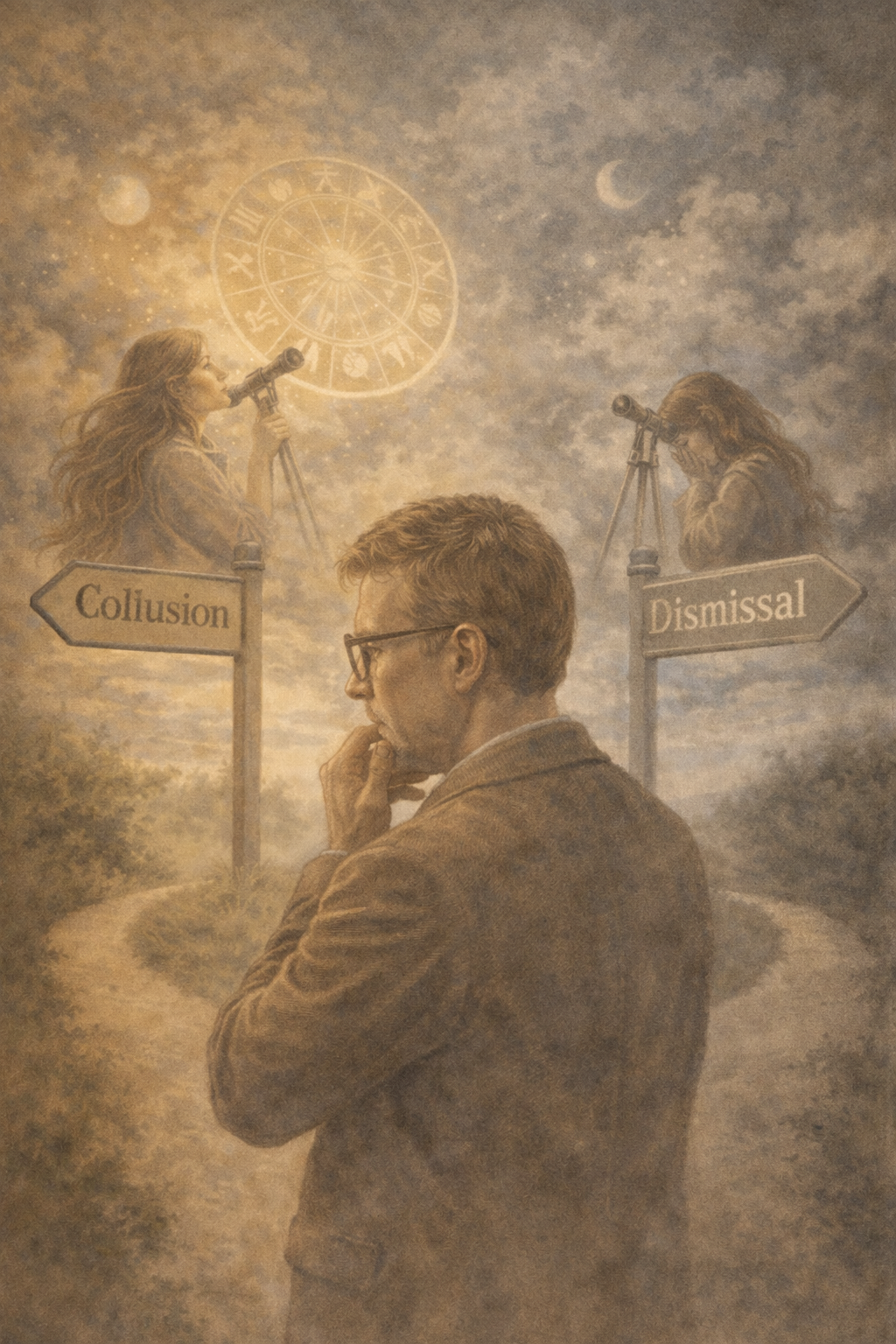
When I first began working with a client who was deeply
invested in astrology, I felt an immediate, familiar trainee response. Not
panic exactly, but a fast internal scan for the “correct” stance. Part of me
worried about collusion: I did not want to slip into validating prediction or
certainty. Another part of me worried about dismissal: I could sense how
central this language was to the client’s inner life, and I did not want to
shame them by treating it as childish or irrational. It felt like standing at a
fork in the road. Do I correct the belief, or do I treat it as meaning?
What steadied me was realising that the therapy room is not
a debate society. I did not need to decide whether astrology was true. I needed
to understand how it was being used. The most helpful question turned out not
to be “Is astrology real?” but “What is astrology doing for this person’s
psyche?” Once I held that frame, my posture softened. I could listen without
either agreeing or attacking. The work became less about a system and more
about a language.
In the early sessions, the client would arrive with chart
interpretations almost like a weather report for the soul. They told me what
was “coming,” what was “blocked,” what was “fated.” I remember feeling a slight
impatience in myself at times, the part of me that wanted to say, gently, “Can
we bring this back to you?” But I also noticed something else: when I
redirected too quickly, the client tightened. Their tone became smaller,
defensive. It was subtle, but I could feel the shame in the room, the sense
that their way of making meaning was being quietly downgraded. That was a
clinical moment for me. I realised that if I took their symbolic language away
too early, I would take away the very bridge that might lead us into the deeper
work.
As I stayed with it, the symbolic texture began to reveal
itself. The client spoke about planets the way other clients speak about moods
or parts of themselves. Saturn was not just a planet. Saturn was heaviness,
duty, delay, the experience of being tested and made to wait. Mercury
retrograde was not “supernatural.” It was a name for disruption,
miscommunication, the feeling that things slip and fray. When they said “Mars
is active,” what I often heard beneath it was a struggle with anger and
assertion, mixed with guilt about wanting anything at all. Over time, it became
clear that astrology was functioning as an organised symbolic vocabulary for
experiences that were otherwise difficult to hold in ordinary language.
The first turning point came when I noticed the rhythm of
anxiety. The client sometimes spoke in a way that sounded like reassurance-seeking,
except the reassurance was coming from the chart rather than from another
person. If the chart suggested difficulty, they became vigilant, braced, almost
scanning the world for confirmation. If it suggested relief, they relaxed.
Astrology was regulating something. It functioned like an external stabiliser.
In attachment terms, it was as if the chart had become a kind of secure base, a
reliable object that soothed uncertainty when human relationships had not
always felt reliable (Bowlby, 1969). I remember the quiet shift in my mind when
I saw this. We were no longer talking about astrology. We were talking about
safety.
As the sessions continued, a deeper theme came into view: a
struggle between longing for control and longing for surrender. The client had
lived through periods of chaos and unpredictability, and astrology gave order.
Even when the predictions were uncomfortable, there was comfort in the idea
that suffering had meaning and a timeline. Psychodynamically, I began to see it
as a defence against helplessness. Not a “bad” defence, not something to rip
away, but a way of coping that protected the client from a very raw fear of
uncertainty. Yet it also came with a cost. At times, it shrank their agency.
“It’s in my chart,” they would say, in the same tone other clients say, “That’s
just how I am.” The language of fate could become a quiet surrender of choice.
Authority, Transference, and the Inner Use of Astrology
Another turning point came when I noticed how the client
related to certain placements as if they were verdicts. Some symbols were
spoken about with pride, even relief, as though the chart had finally explained
them. Others were spoken about with dread, as if they were condemned to a
particular fate. In those moments I found myself thinking of Freud’s model of
the psyche, and particularly the Superego. I began to wonder whether the chart
was functioning as a kind of externalised Superego narrative. Instead of an
inner critic saying “you must” or “you are failing,” the chart said “you will.”
Shame became cosmic rather than personal. It did not feel like superstition in
the room. It felt like psychology wearing mythic clothing. When we could name
this gently, the client began to separate symbol from sentence. The chart could
be a metaphor, not a prison (Freud, 1923).
What surprised me was how quickly transference began to
weave itself through this material. At times, the client positioned me as an
interpreter, almost a priest of meaning. There was an unconscious hope that I
would confirm their readings and relieve their uncertainty. At other times, I
was experienced as a sceptical authority they needed to persuade. I could feel
the push-pull between wanting my validation and fearing my judgment. We did not
need to argue about astrology to work with this. We could work with what was
happening between us: the longing to be taken seriously, the fear of being
dismissed, and the need for a reliable other who could hold complexity without
collapsing into certainty.
As the work deepened, I realised astrology was not simply
something the client believed. It was a relationship. It was how they related
to time, fate, desire, fear, and meaning. It was a structure that held their
inner life when that inner life felt too large. Once I understood that, therapy
shifted again. We began to ask different questions. When Saturn felt heavy,
what was the emotional burden? When Venus felt “blocked,” what was happening in
intimacy? When the client feared a coming transit, what older story of loss or
punishment was being activated?
Archetypes, Myth, and the Collective Unconscious
This is where I began to reflect more broadly on the
collective layer of symbolism. Astrology has survived for centuries not only
because people used it for prediction, but because it carries archetypal images
that human beings recognise immediately: the warrior, the lover, the judge, the
messenger, the exile, the elder. These figures are embedded across myth,
religion, folklore, and literature. They persist because they describe
recurring human dilemmas and roles rather than technical categories (Jung, 1959) and (Campbell, 1949). In the therapy room, it became clear that my client was not
merely speaking about planets. They were speaking in a symbolic tradition that
has given humans a way to narrate experience across generations.
From a Jungian perspective, this makes sense. Archetypes are
not inherited ideas but inherited organising principles that shape how
experience takes form. Cultural symbols are expressions of these deeper
patterns, not their source (Jung, 1959). Astrology can be understood as one of
the historical languages that has carried archetypal material across time,
refined through repetition, and embedded into cultural memory. This is why
astrological symbols can feel so psychologically saturated: they do not arrive as
neutral concepts, but as figures already loaded with mythic weight. Hillman
takes this further, suggesting that the psyche is fundamentally mythic and that
we are often lived by stories before we can name them (Hillman, 1975) and (Hillman,
1996). In this view, astrology is less “supernatural” than historical: a
culturally inherited map of recurring human themes that remains alive because
the experiences it symbolises remain alive.
Fate, Agency, and the Therapeutic Task
So where did this leave me, as a trainee therapist? I came
to see that what we call fate may sometimes be the felt experience of an
autonomous pattern taking hold. Jung’s idea of an archetype constellating
captures this: when an archetypal configuration is activated, it gathers
emotional energy and can overwhelm the ego’s sense of authorship. Life begins
to feel scripted, as if something ancient is writing through us. In my client’s
world, astrology provided the symbolic frame that made that experience intelligible.
The “fated” quality did not prove external determination; it revealed the force
of an internal narrative rooted in archetypal material and reinforced by
centuries of symbolic meaning.
What I learned, ultimately, is that symbolic systems do not
need to be literally true to be psychologically powerful. The clinical question
is not “Do I believe this?” but “How is this being used?” When astrology
supported reflection, emotional articulation, and meaning-making, it became a
bridge into the client’s inner world. When it hardened into certainty and
fatalism, it functioned more like an avoidance of feeling and choice. My task
was to stay curious about that difference, and to help the client relate to
their symbolic language more consciously, so that it could become something
they interpreted rather than something that silently dictated the script.
Therapy does not require the client to abandon their myth.
It asks whether the myth can become conscious. If archetypes do in some sense
write stories through us, then astrology may be one of the older scripts the
psyche reaches for. Therapy, at its best, is where the script can be read
aloud, questioned, and gently rewritten, without humiliating the part of the
person that needed it in the first place.
Summarising Reflections and Looking Ahead
Symbols and symbolic language are, in many ways, the native
language of both the personal unconscious and what Jung called the collective
unconscious (📝Symbolic language is also a fundamental part of dream analysis and interpretations which we will discuss in the future). When we move away from the purely rational surface of the mind and
into deeper psychic territory, the psyche rarely speaks in neat concepts or
linear explanations. It speaks in images, metaphors, stories, and patterns. In
other words, it speaks in symbolic architecture. This is one of the reasons
dreams matter so much in depth psychology: they show how the unconscious
communicates. Dreams do not usually arrive as straightforward statements; they
arrive as symbolic scenes, condensed images, and emotionally charged narratives
that require interpretation rather than literal reading (Jung, 1964) and (Freud,
1900).
From a psychodynamic and Jungian perspective, this is not
accidental. The unconscious holds material that is not fully integrated into
ordinary awareness, including conflict, desire, fear, memory, shame, and
longing. When that material finds a route into consciousness, it often does so
through symbolic form, because symbols can hold ambiguity. A symbol can carry
multiple meanings at once, which makes it uniquely suited to psychic life,
where feelings are rarely single-layered. Jung argued that symbols are not
merely disguises but are transformative carriers of meaning; they do not only
“hide” something, they also allow something to be known without being flattened
into a single explanation (Jung, 1959) and (Jung, 1964). Freud, from a different
angle, described dreamwork as involving processes like condensation and
displacement, where deeper wishes and conflicts are expressed indirectly
through imagery and narrative (Freud, 1900).
So what does this mean for the themes I have been exploring
around astrology, archetypes, and mythic patterning? It suggests that when a
client speaks in symbolic systems, whether astrology, religion, mythology, or
recurring dream images, they may be speaking in the psyche’s preferred
language. The clinical task is not to treat this language as irrational, nor to
literalise it into “facts,” but to listen for what the symbols are organising
emotionally and relationally. Symbols are often the psyche’s way of making the
unsayable speakable.
And this is exactly why I’m going to start a new thread (what! not again!). Because there is a Part 2 to this. If Part 1 was about how symbolic systems like astrology can operate in the therapy room as a psychological language, Part 2 will go deeper into the question of what happens when symbols and archetypes become too literal, too rigid, or too “fated.” I want to explore the difference between being possessed by a symbolic narrative and being in relationship with it. In other words, the difference between living inside a story unconsciously and learning to read the script with enough awareness to regain choice.
Now, I have already touched on this especially the “possession” side on my Archetypes page, When Patterns Start Behaving Like People. In that piece I described a strange clinical feeling: that sometimes it’s less like people “have” patterns, and more like patterns have people. Clients can arrive with utterly personal stories and yet the emotional atmosphere in the room can suddenly swell beyond the facts, as if something older has arrived and wants to be lived out. This sits closely with Jung’s view that archetypal patterns are not just ideas but organising structures that can behave with a kind of autonomy in psychic life (Jung, 1959) and (Samuels, 1985). I also wrote about what can happen when a pattern is named: how it often intensifies at first almost as if it is resisting being made conscious before it becomes more workable and negotiable in the relationship (Jung, 1959) and (Stein, 1998).
Part 2 is where I want to bring that same lens to symbols more explicitly especially the kinds of symbolic systems people use to organise meaning outside therapy: astrology, “signs,” synchronicity, fate-language, spiritual narratives, even psychological labels when they’re used like destiny. Jung’s basic point still holds: the psyche needs symbols. Symbols can give shape to experience and offer images for what cannot yet be spoken plainly, acting as a bridge between felt experience and reflective understanding (Jung, 1964). But when an image is treated as a literal fact rather than a living symbol, it can harden into a script. The symbol stops being a bridge and becomes a verdict. The person stops asking, “What is this trying to show me?” and starts declaring, “This is what I am, this is what will happen, this is who they are.” That’s when meaning becomes captivity (Jung, 1964).
This is the subtle danger of “fate” thinking: it can feel comforting, because it reduces uncertainty and gives a clean explanation for complex longing, fear, shame, desire. It can also function as a defence. If a relationship collapses, it was “Saturn.” If a boundary was crossed, it was “the archetype.” If we repeat a pattern, it was “meant to be.” Hillman is helpful here because he respects the intensity of images without letting them become excuses; he asks us to stay with the image without surrendering moral agency to it (Hillman, 1975). Knox brings it down to earth again: many experiences that feel “fated” are also deeply learned relational expectations attachment templates encoded early and repeated later, powerful precisely because they once served survival (Knox, 2003).
Clinically, what matters to me is not whether a symbolic system is “true” in a cosmic sense, but what it does inside the psyche and inside relationships. Does it widen the person’s inner space, or shrink it? Does it create curiosity, or foreclose it? Does it help someone tolerate ambiguity and complexity, or does it offer a totalising explanation that prevents contact with grief, responsibility, and choice? Winnicott might describe the healthiest use of symbol as occurring in a transitional space alive, flexible, “as if,” capable of play whereas a rigid, literal use collapses play into compulsion and certainty (Winnicott, 1971). And once certainty takes over, language can become a way of avoiding the human reality of consequence something any therapeutic frame has to keep bringing back into view (Wachtel, 2011).
So Part 2 will be a careful attempt to describe how symbols can help us think and also how they can sometimes think for us. I want to explore the moment a symbolic narrative becomes a possession: when it replaces ordinary perception, when it recruits the body into certainty, when it narrows relationships into roles, when it turns longing into destiny and fear into prophecy. And I want to offer the alternative stance: a more dialogical relationship with symbols one that honours their depth, but keeps the human person (and the ethical reality of consequences) in the centre. Because the goal isn’t to abolish story. The goal is to stop being trapped inside it.
References
- Freud, S. (1900) The Interpretation of Dreams. In: The Standard Edition of the Complete Psychological Works of Sigmund Freud, Vols. 4–5. London: Hogarth Press.
- Jung, C.G. (1959) The Archetypes and the Collective Unconscious. London: Routledge.
- Jung, C.G. (1964) Man and His Symbols. London: Aldus Books.
- Bowlby, J. (1969) Attachment and Loss: Volume I – Attachment. London: Hogarth Press.
- Campbell, J. (1949) The Hero with a Thousand Faces. Princeton: Princeton University Press.
- Freud, S. (1923) The Ego and the Id. In: The Standard Edition of the Complete Psychological Works of Sigmund Freud, Vol. 19. London: Hogarth Press.
- Hillman, J. (1975) Re-Visioning Psychology. New York: Harper & Row.
- Hillman, J. (1996) The Soul’s Code: In Search of Character and Calling. New York: Random House.
- Jung, C.G. (1959) The Archetypes and the Collective Unconscious. London: Routledge.
- Winnicott, D.W. (1971) Playing and Reality. London: Tavistock Publications.
- Wachtel, P.L. (2011) Therapeutic Communication: Knowing What to Say When. New York: Guilford Press.
- Knox, J. (2003) Archetype, Attachment, Analysis: Jungian Psychology and the Emergent Mind. Hove and New York: Brunner-Routledge.
- Samuels, A. (1985) Jung and the Post-Jungians. London: Routledge.
- Stein, M. (1998) Jung’s Map of the Soul: An Introduction. Chicago, IL: Open Court.